Monday, February 25, 2013

Lessons learned from the Daytona 500


Sunday afternoon, Jimmie Johnson won his second Daytona 500, this one a relatively boring single-file, follow-the-leader affair punctuated by two multi-car accidents and 1,489 on-air Danica Patrick references. As the series moves to its second round in Phoenix, the following is what we learned from Daytona:


The first 2/3rds of the race are still there to get to the last 1/3
The 500 was way too much fizzle, not enough sizzle, and maybe with what happened at the endof Saturday’s Nationwide race, that was okay. Still, the lack of moves made the race almost unwatchable. The fact it was the first race of the year and the Daytona 500 – about as exciting as it gets - made it just barely bearable. But, what happens when the series moves to Phoenix?

NASCAR can tend to be a repetitive, monotonous left-turn affair, particularly with so many 1.5-mile ovals on the schedule. On TV, it’s frequently difficult to discern where the race is actually taking place. The good news is Phoenix is decidedly different, both in track layout and in how the cars will be configured.

The new generation cars will run a rear spoiler twice the size as the ones run at Daytona and, of course, be freed of the restrictor plate. Look for cars to be more responsive, and with the draft minimalized, it will be more rewarding for drivers to dip out of the top line and run low in the corners to argue positions.

Still, the first half isn’t as much about the racing as it is biding time. For the drivers, it’s to stay on the lead lap; for the viewer, it’s time to make sure you’re fed and well rested for when the racing gets serious toward the end.

New cars or not, the field is deep
NASCAR’s new generation of cars bring distinct shapes back to each car manufacturer, something fans wanted to see. With different aerodynamic shapes, there’s always fear that one car will outperform another. Daytona saw each marque spend time up front looking like the car to beat.

The field is deep. At every race this year, there will be at least 20 cars out of the 43 car field that will be strong, realistic contenders for the win. But, did you notice the final results of the Daytona 500? Reagan Smith finished 7th, Michael McDowell finished 9th, and J.J. Yeley finished 10th – all underfunded underdogs in the garage, yet top ten finishers in the sport’s biggest race.


New cars mean most teams are together at this point in the learning curve. In time, the best organizations with the biggest resources will make their way to the top. In the meantime, look for the mid-level teams to sneak into high finishing positions. They might not win, but they will be taking points away from contenders for the season championship, a story you’ll see plenty of as the season progresses.

Danica Patrick will receive the majority of media attention this year.
Danica Patrick won’t simply receive more media attention than any other driver, rather she will receive more media attention this season than all the other drivers. Combined. Together.

Patrick has always been a media darling, no small part to her good looks, which thus far in her career has far exceeded the results she has delivered on track – without some victories, she’s in danger of becoming racing’s version of Anna Kournikova. This year, Patrick seems more comfortable in front of media and the fans, and her performance at Daytona showed when she’s comfortable, she can produce.


Unfortunately, she’s not going to be comfortable at most tracks. Patrick has always shined at the biggest, most storied tracks in the series she has raced – Indianapolis and Daytona. At both places, she excels, as she’s most comfortable running flat out and breathing the throttle to adjust her pace.

Where Patrick has struggled in her career is braking and rolling back on the throttle. Look for her to be mid-pack in most races that are contested at tracks other than Daytona or Talladega. Regardless, you’ll still hear about where she is, no matter where she is. Just like you will always know who is in the lead, all year you will know where Patrick is running.

You might not hear “Paul Menard is running in 21st,” but you’ll certain hear “Dana Patrick is running 22nd.”

Run hot laps on Twitter @RayHartjen

Friday, February 22, 2013

4 things to watch for in Sunday’s Daytona 500


With the off-season now in the books, NASCAR kicks off its 2013 season this Sunday with its crown jewel, the Daytona 500. I know what you’re thinking:  “There was an off-season?”

Oh yes, the longest season of any professional sport enjoyed a three month break, and engines have been piercing the quiet now for almost a week as crews have been getting new generation cars ready for the biggest stock car race of them all. As you ready yourself, here are four things to watch for in Sunday’s race.

Expect to hear “Danica” as often as you hear “Daytona.”
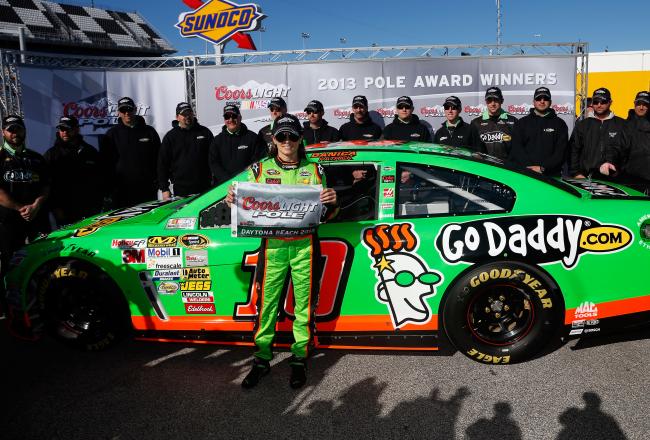
As if the media firestorm that is Danica Patrick needed any further fuel, Patrick’s performance on Sunday in winning the pole position for the race only fanned the flames. Becoming the first woman to qualify fastest in NASCAR’s premier series, Patrick ensured she’ll be the focus of most pre-race discussion, as if she wasn’t already one of the leading storylines going into the event.


Patrick’ best finish in NASCAR Sprint Cup is 17th, and she has only a single top-five finish in 58 starts in NASCAR’s second-tier Nationwide Series. Coupled with just a single race victory in any motorsports series in well over a decade, you can expect Patrick’s performance to fall well short of her hype.

In the restrictor plate era, the fastest car alone on the track, as Cup cars qualify, ordinarily isn’t the fastest car in a pack, as Cup cars race. Look for Patrick’s relative lack of experience to keep her just out of Victory Lane.

The Pack Is Back
Rules packages the past two seasons have seen restrictor plate races – Daytona and Talladega – devolve into two car do-se-do’s, with pairs hooking up in tandem, nose-to-tail,  and logging lap after lap in a manner that most race fans tired of quickly. This year dawns a new car design, and while crews and drivers are struggling to unlock all the secrets of the car, this they have already figured out:  the fastest way around the track is in a pack, not a pair.

While the cars have changed, two things haven’t:  the best teams are the best teams and the best drivers are the best drivers. Look for two packs to form. A large pack of 25 or so contenders will race nose-to-tail, side by side, two-wide, at the front of the field, with an occasional try at  three-wide coming through Turn Two and onto the backstretch. A few seconds behind the first pack, you’ll see the second bunch, made up of cars struggling for handling and pace, as well as the conservative contender looking to stay out of …

The Inevitable “Big One”
The “Big One” is the nickname given by the racing community – racers and fans alike – to the huge multi-car wrecks that happen with regularity at high speed, restrictor plate ovals like Daytona. For the 500, there’s the extra ingredient of aggressive greed. Second at Daytona is really first loser, and no driver will be looking for points toward the championship knowing there is ample time to make up and lost ground after just one race (see longest professional sport season, above).

Rather, drivers would gladly trade a Sprint Cup series championship for a Daytona 500 victory. Pack racing plus aggressive, go-for-broke driving usually equals a “big one.” Look for several contending cars to be sidelined as nothing more than steaming, crumpled wrecks well before the final ten laps. Then, don’t be surprised if there’s another “big one” the final ten laps.

Smoke Rises to the Top


Tony Stewart is second in the all-time Daytona wins list with 18 victories at the historic track, trailing only the legendary Dale Earnhardt. However, none of Stewart’s victories have taken place in the big Sunday race, the Daytona 500. In his 14 years racing in Sprint Cup, Stewart has 47 wins (in 500 starts) and three Cup championships, along with another 12 combined victories in the Nationwide and Truck series. Simply, “Smoke” is due. Look for Stewart to win the race or cause the “big one” trying.

See you at the track.

Take the race on a Sunday drive on Twitter @RayHartjen. 

Tuesday, November 27, 2012

3 Reasons Nico Hülkenberg’s Move to Sauber Might Be the Right One


Sunday saw the conclusion of the 2012 Formula 1 season, and most eyes were riveted to the exciting battle that saw Sebastian Vettel escape with his third consecutive title by the narrowest of margins over Fernando Alonso. However, the revelation of the race may well have been Nico Hülkenberg, driving in his final race for Force India before moving to Sauber in 2013. Hülkenberg led his first ever race laps and looked to be a strong contender for the maiden win – both for him and Force India – until he collided trying to overtake Lewis Hamilton in turn one as the race wound down, eventually shuffling down to fifth at the checkered flag.


 Many F1 pundits, most notably Speed’s David Hobbs, think Hülkenberg might be taking a step backwards on the F1 grid by voluntarily moving from Force India to Sauber, based primarily on the pace of the respective cars late in the season. Taking a deeper look, however, three points arise that suggest Hülkenberg’s move might be the right one to make.

Sauber finished  6th in the 2012 Constructors’ Championship, Force India 7th
For Force India, it was a tale of two seasons, with the first 10 races producing 46 points, the second 10 races delivering 63. Conversely, Sauber broke from the gates well, earning 80 points over the first half, then holding on to its position by scrambling for just 46 points in the second. Hobbs and others look to that trend in questioning Hülkenberg’s decision.

Not so fast.

Sauber produced the best chances to win in 2012, finding itself on the podium in four races – two seconds and two thirds - while Force India’s best finishes were off the podium – two fourths and two fifths. When Sauber is at its best, its best is better than Force India’s, and Hülkenberg is looking to stand on the F1 podium for the first time in his young career. If 2012 is any indication, Sauber affords the best opportunity.


 Hülkenberg responsible for much of Force India’s 2012 success
Force India outperformed Sauber over the second half of the season, but most of that was attributable to Hülkenberg himself, as he regularly outperformed teammate Pal Di Resta, outscoring him in six races, and scoring a total of 44 points to Di Resta’s 19. Comparatively, Sauber’s driver tandem of Kamui Kobayashi and Sergio Pérez scored 27 and 19 points respectively, matching or outpacing Di Resta, even with Pérez seemingly checking out after signing with McLaren for 2013, getting shut out of the points the final six races. So, yes, while Force India outperformed Sauber over the last ten races, Hülkenberg was the driver responsible for the majority of that performance.

Sauber runs Ferrari engines while Force India runs Mercedes
Not for nothing, Sauber powers its chasses with Ferrari engines. This isn’t to suggest the Ferrari power plant provides a competitive advantage over the Mercedes of Force India. Rather, the suggestion is for future driving opportunities. Ferrari’s Felipe Massa was lucky to hold onto his drive for 2013, and if he repeats his disappointing start to the season, driver succession rumors will flying by early summer. If so, Hülkenberg, driving for a Ferrari customer team, will instantly find himself in consideration to fill the seat in the prancing horse of the Scuderia. The road upwards in the Mercedes camp is much more cluttered, with both Mercedes and McLaren both seemingly set for several years.


2013 will tell the story
There you have it – three reasons to suggest that Hülkenberg might have made the proper decision to leave Force India for Sauber. The key word, of course, being “might.” The balance of the 2013 season will tell the story, and it all starts March 17 in Melbourne, Australia. 

Run hot laps on Twitter @RayHartjen

Saturday, October 20, 2012

F1 Constructors’ Grade Report – Gearing up for Final Exams


With 80% of the Formula One season in the rear view mirror, the Constructors are gearing up for the stretch run and their final marks for the 2012 season. So, to aid them in their preparations, below are their final mid-term grades before report cards come out.


Red Bull Racing-Renault
A-. Despite leading the standings handily and the heavy favorites to win a third consecutive Constructors’ championship, Red Bull pulls only an A- thus far in a wildly inconsistent – for them – campaign. Red Bull has fought all season to get solid results from both cars during race weekends, and the struggle has paid off the last two races. Look for Red Bull to ...

Read the rest of the post on Yahoo! here. 

Monday, October 8, 2012

Formula One for Dummies: F1 Racing Returns to America


Formula One returns to the United States for the first time since 2007 with the running of the U.S. Grand Prix November 16-18, hosted at the sparkling-new Circuit of the Americas track outside Austin, Texas. The pinnacle of motorsport around the world, F1 is an almost forgotten series in the minds of many American race fans, finding itself lapped, if you will, by NASCAR in popularity and viewership. Even the anemic draw of the IndyCar series outperforms F1 in the states.


 All that’s set to change, with the Austin race joined next year by a new street circuit in New Jersey, right on the banks of the most impressive skyline view of New York City. So, to mark the occasion of F1’s re-emergence in the U.S., here’s a quick lesson in F1 101, or “F1 for Dummies.”

Read the complete post on Yahoo! here. 

Thursday, September 27, 2012

Reno Air Races Resume Amid Remembrance


Motorsports and racing are inherently dangerous. Where men and women push the limits of performance in competition, equipment breaks or mistakes are made, and accidents happen, the outcomes of which are sometimes tragic.

No form of motorsport is immune, despite the tremendous efforts of organizers, promoters and sanctioning bodies to emphasize safety, and when tragedy strikes it can be indiscriminate, taking a sport’s biggest stars like Ayrton Senna and Dale Earnhardt, or its promising up-and-comers like ...

Read the full post on Yahoo! here.


Tuesday, September 25, 2012

Reno Air Races Test PIlots' Skills Just 50 Off Deck


Stephen Partridge-Hicks, known simply as “SPH,” knows a day flying is a day well spent, his smile when climbing into the cockpit surpassed only by the smile when getting out. However, one week a year, his smiles are bigger and last longer, and it happens each September at the National Championship Air Races in Reno, Nevada. 

A native of the United Kingdom, SPH came about flying the Miss USA Formula One race plane through his friendship with Thom Richard, co-founder of Warbird Adventures in Kissimmee, Florida. “Thom told me how much fun he had racing this plan and that he thought I could race her too,” said Partridge-Hicks, “so I thought I would give it shot.”

(Read the full post on Yahoo! here)